


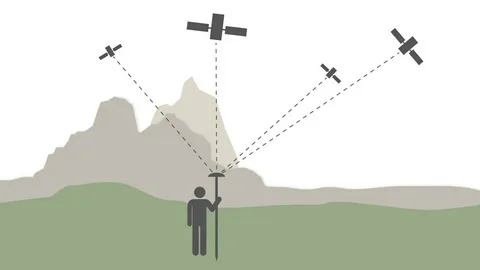
In the world of precise navigation and surveying, rtk gps Explained: How Centimeter-Level Positioning Really Works is a topic that continues to intrigue engineers, surveyors, and technology enthusiasts. RTK, or Real-Time Kinematic GPS, is a technique that allows GPS devices to achieve accuracy at the centimeter level—a massive improvement over the typical meter-level accuracy of standard GPS systems.
What is RTK GPS?
RTK GPS is an advanced positioning technology that uses satellite signals to determine location with extraordinary precision. Unlike conventional GPS, which can have errors of several meters due to atmospheric conditions, satellite clock discrepancies, and other factors, RTK GPS corrects these errors in real-time using data from a base station.
How It Works
RTK operates by using a network of two main components:
- Base Station: A stationary GPS receiver placed at a known location. It calculates the difference between its known position and the position reported by satellites.
- Rover Unit: A mobile GPS receiver that receives both satellite signals and correction data from the base station.
The base station sends correction signals to the rover, allowing it to compensate for errors and calculate its position down to a few centimeters. This is why RTK GPS is often described as centimeter-level positioning technology.
Applications of RTK GPS
The ability to determine exact positions in real-time has made RTK GPS indispensable across multiple industries:
- Agriculture: Precision farming uses RTK GPS for planting, fertilizing, and harvesting with minimal overlap and waste.
- Construction: RTK GPS ensures accurate site layout and machine guidance for earthmoving and building projects.
- Surveying: Land surveyors rely on RTK for mapping and property boundary measurements.
- Autonomous Vehicles: Self-driving cars and drones utilize RTK GPS to navigate safely and efficiently.
Advantages of RTK GPS
Using RTK GPS comes with significant benefits, including:
- High Accuracy: Provides centimeter-level positioning for precise applications.
- Real-Time Corrections: Eliminates delays in measurement by sending immediate corrections.
- Cost Efficiency: Reduces errors and rework in industries like construction and agriculture.
Challenges and Limitations
While RTK GPS is highly accurate, it does have some limitations:
- Signal Obstruction: Buildings, trees, or mountains can interfere with satellite signals.
- Limited Range: The rover must be within a certain distance of the base station for optimal performance.
- Complex Setup: Requires both hardware and software knowledge to operate correctly.
Conclusion
Understanding RTK GPS Explained: How Centimeter-Level Positioning Really Works is essential for anyone looking to leverage high-precision GPS technology. By combining a base station with a rover unit and real-time correction data, RTK enables accuracy that standard GPS simply cannot match. Its applications across agriculture, construction, surveying, and autonomous vehicles continue to expand as technology evolves, making it one of the most revolutionary tools for precise positioning today.
